
How to Hire an Embedded Firmware Engineer Who Can Bring Up Silicon
Bare-metal, RTOS, BSP, safety-critical: 'embedded' covers very different jobs. How to scope and hire the firmware engineer your bring-up actually needs.
"Embedded firmware engineer" is one of the most overloaded titles in hardware. It can mean someone who writes bare-metal interrupt handlers, someone who lives in an RTOS, someone who brings up embedded Linux on brand-new silicon, or someone who optimizes DSP code. Hire the wrong type for your problem and you will not find out until the bring-up stalls. Scoping the role correctly is most of the battle.
Embedded Is Not One Job
The work spans a wide spectrum. Bare-metal firmware runs directly on a microcontroller with no operating system, all registers and interrupts. RTOS-based firmware runs on a real-time operating system with tasks, scheduling, and deterministic timing. Embedded Linux and board-support-package work brings up new hardware platforms. DSP firmware optimizes signal-processing algorithms for throughput. These are different skill sets, and the right hire depends entirely on which one your platform needs.
Scope the Hire to the Problem
Before you write the job description, name the actual work: bootloader and secure boot, device drivers for specific peripherals, BSP bring-up on a new SoC, an OTA update mechanism, or power management. A board-support-package engineer who can make brand-new silicon boot and talk to its peripherals is a different, and often scarcer, hire than an application-layer developer who works on top of a platform someone else stood up.
The Hardware/Firmware Boundary Is Where Value Lives
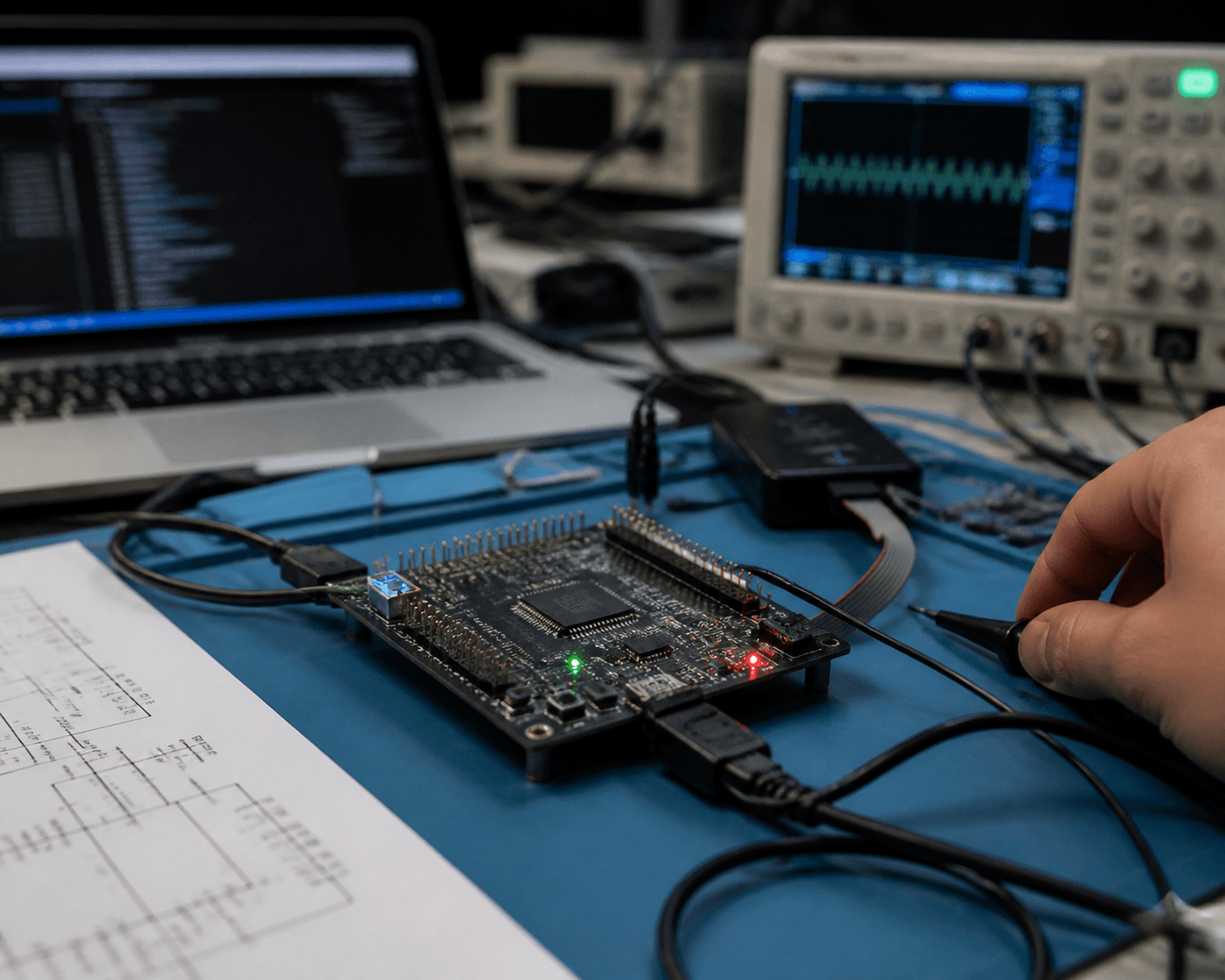
The most valuable embedded engineers can debug a problem that crosses the hardware/firmware boundary: read the schematic, probe the signal with an oscilloscope, and figure out whether the peripheral that will not enumerate is a driver bug or a board problem. That ability, the 3 a.m. bring-up instinct, is what separates a true embedded engineer from someone who has only worked above the hardware abstraction layer. No model and no amount of application experience substitutes for it.
Domain Changes the Hire
The same title means different work in different industries. Automotive demands MISRA C discipline, AUTOSAR architecture, and an ISO 26262 development process. Avionics requires DO-178C software certification. Medical devices require IEC 62304 lifecycle compliance. An engineer who cannot speak to the relevant standard for your domain has not actually done that domain, whatever the resume says.
RTOS Depth Signals Seniority
A strong embedded engineer can explain why they chose a particular real-time operating system for a product, not just that they used one. Whether the platform is FreeRTOS, Zephyr, Wind River VxWorks, or QNX for automotive and medical, the rationale behind the selection, timing determinism, certification, footprint, ecosystem, is what reveals seniority.
How Game 7 Places Embedded and BSP Engineers
Game 7 Staffing recruits only in semiconductor, hardware, and platform software, so we scope embedded roles to the actual problem and screen for real bring-up ability before you see a candidate. Tell us what you're building, and we'll scope out what you need with our network of 50,000+ vetted engineers.
FAQ
Frequently Asked Questions
What types of embedded firmware engineers are there?
Broadly four: bare-metal (no OS, direct register and interrupt work), RTOS-based (FreeRTOS, Zephyr, VxWorks, QNX), embedded Linux and BSP, and DSP firmware. They are distinct hires, and matching the type to your platform matters more than the generic 'embedded' label.
What is a BSP engineer?
A board-support-package engineer brings up new hardware: bootloader, device tree, kernel drivers, and board initialization. They are critical at SoC and processor companies, where someone has to make brand-new silicon boot and talk to its peripherals.
What domain experience should I require?
It depends on the product. Automotive needs MISRA C, AUTOSAR, and ISO 26262 experience; avionics needs DO-178C; medical needs IEC 62304. An engineer who cannot speak to the relevant standard has not done that domain.
How do I screen for real bring-up ability?
Ask the candidate to walk through a bug that crossed the hardware/firmware boundary, one they root-caused by reading the schematic and probing signals with an oscilloscope. That story separates true bring-up engineers from application-layer developers.
Written by
Game 7 Staff