The STA Engineer Who Owns Signoff: Why Timing Closure Talent Is Scarce
Static timing analysis gates every tape-out. What a signoff-level STA engineer owns, the PrimeTime/MMMC depth to look for, and how to hire one.
Static timing analysis is the gate between a design that looks done and a design that is actually ready for the foundry. Nothing tapes out until the timing signs off, which makes the engineer who owns that signoff one of the highest-leverage and least-understood hires on a back-end team. Get it wrong and you either ship a chip that fails in silicon or burn weeks chasing timing problems that were never real.
Why STA Is the Gate Between Design and Tape-Out
Every path on the chip has to meet its timing constraints across every operating condition, or the part does not work reliably. The STA engineer is the one who proves that, and who decides when the analysis is trustworthy enough to sign. It is a role defined less by running a tool than by knowing when the tool is telling you the truth.
What Signoff-Level STA Actually Involves
Signoff timing is multi-mode, multi-corner (MMMC) analysis across the full set of process, voltage, and temperature corners, covering setup and hold, clock skew, and the on-chip variation models (OCV, AOCV, and POCV) that make the analysis realistic at advanced nodes. As the IEEE IRDS roadmap documents, variation effects grow more severe with each node, so the margining strategy an STA engineer chooses has a direct effect on whether the design is over-constrained (and loses performance) or under-constrained (and fails).
PrimeTime Is the Gold Standard, but the Skill Is Judgment
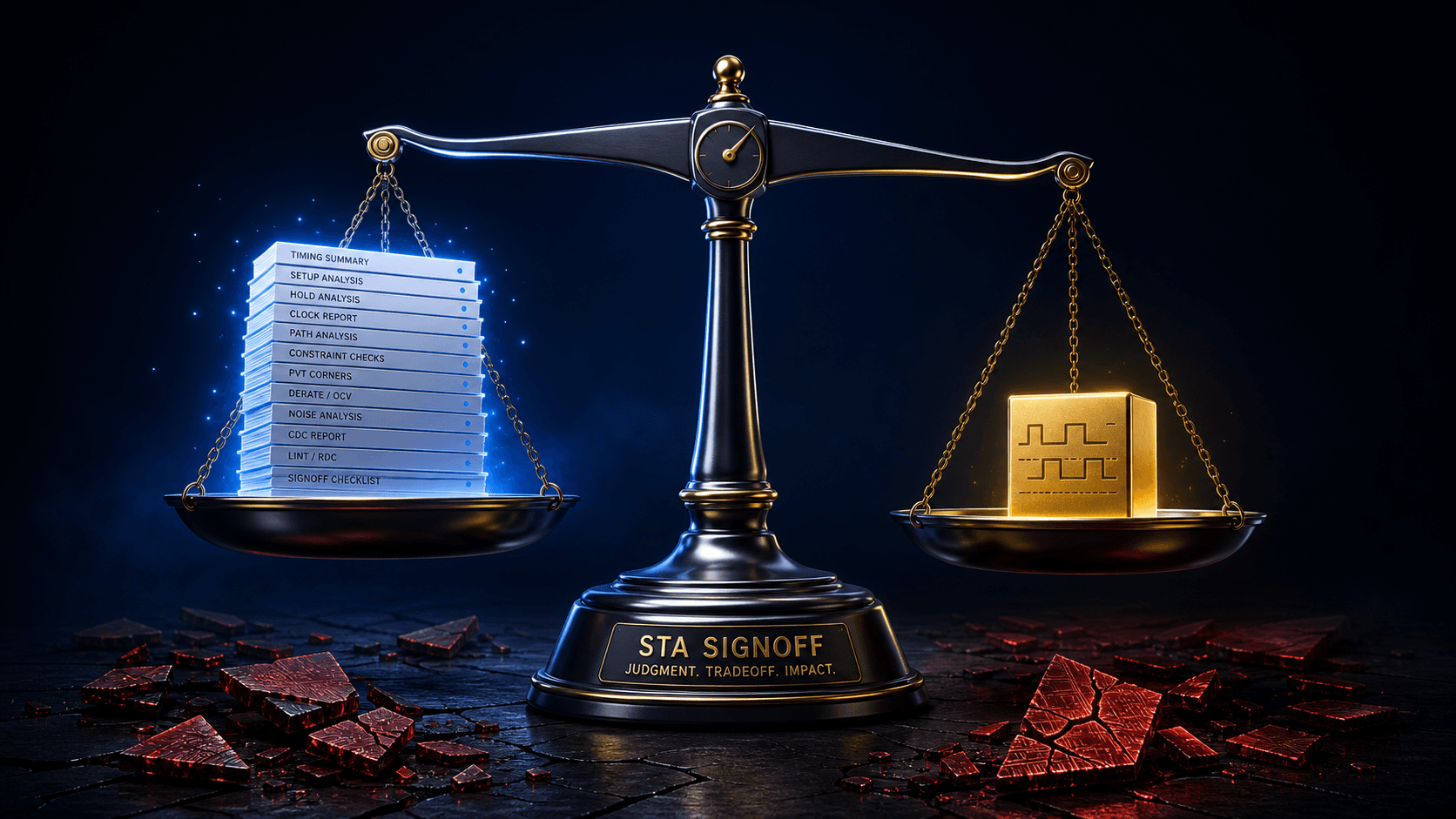
Synopsys PrimeTime is the industry signoff timer, with Cadence Tempus as the other major option. But naming the tool is the easy part. The skill is in reading a violation report and knowing whether it is a real failure, a constraint problem, or tool noise, and knowing which of those to fix and which to waive. That judgment is what separates an engineer who runs STA from one who owns it.
Constraints Are Where Chips Go Wrong
Timing results are only as trustworthy as the constraints behind them. Bad SDC (Synopsys Design Constraints) produces false closure, where the report looks clean but the silicon is not, or it sends the team chasing ECOs that fix nothing. A strong STA engineer treats constraint quality as a first-class deliverable, because garbage-in produces confidently wrong sign-off.
Senior vs. Principal STA
A senior STA engineer runs the analysis, debugs violations, and closes timing under direction. A principal owns the signoff criteria itself: which corners are signoff corners, how variation is modeled, and the final waive-or-respin call on a violation that cannot be closed with an ECO. The principal is accountable for the statement that the chip is timing-clean, which is a different weight of responsibility.
Screening Questions That Reveal Depth
• Walk me through your MMMC setup on your last tape-out: which corners were signoff corners, and why?
• How do you decide between OCV, AOCV, and POCV, and what does that choice cost you in margin?
• Tell me about a timing violation you chose to waive at signoff. What was your reasoning?
Specific, confident answers indicate someone who has owned signoff. Generic answers about running the flow indicate someone who has executed it under someone else's ownership.
How Game 7 Places STA and Timing Engineers
STA is a specialty within the back end, and on large programs it is often a distinct hire from physical design. Game 7 places timing and signoff engineers who have owned closure on real tape-outs, matched to the node and complexity of your program. Share what you're looking for to get the right engineer placed at the right time in your program, or if you are an STA engineer, share your background and let's connect to see where your career trajectory can take you.
FAQ
Frequently Asked Questions
What does an STA engineer do?
A static timing analysis engineer verifies that a design meets its timing across every process, voltage, and temperature corner and operating mode (multi-mode, multi-corner) using PrimeTime or Tempus. They own setup and hold closure and the timing portion of tape-out signoff.
Why is good SDC so important to timing closure?
Timing results are only as trustworthy as the constraints behind them. Poor SDC produces false closure or sends the team chasing ECOs that do not fix the real problem, which is why constraint quality separates strong STA engineers from the rest.
What are OCV, AOCV, and POCV?
They are progressively more accurate ways of modeling on-chip variation so that timing signoff is realistic at advanced nodes. A principal STA engineer knows when and how to apply each one rather than over- or under-margining the design.
Is STA a separate hire from physical design?
On large programs, often yes. A dedicated STA/timing engineer owns signoff criteria and corner analysis while the physical design team owns implementation, though the two work in tight feedback loops.
Written by
Game 7 Staff