Why the Embedded Firmware Engineer's Job Has Never Been Harder or Better Paid
Three simultaneous demand waves are reshaping embedded firmware. Here's what's driving them, why ASIL-D experience commands a premium, and how to pick your specialization.
The embedded firmware engineer has always been underestimated. That's changing fast, and in three directions at once.
Three simultaneous demand waves are converging on the same thin pool of engineers: automotive electrification requiring safety-critical firmware, AI moving to the edge requiring inference stack integration, and increasingly complex SoC bringup requiring engineers who can debug across the hardware and software boundary. The combination has made the role harder than it was five years ago, and has moved compensation meaningfully upward for engineers who've built real depth in any one of those three areas.
Three Waves, One Shortage
Start with what's actually driving demand, because it's not one thing.
Automotive electrification - ADAS, V2X, battery management systems - has turned embedded firmware requirements from support work to load-bearing. Every safety-critical function in a modern vehicle runs on firmware that must meet ISO 26262 functional safety requirements, implement AUTOSAR Classic or Adaptive architecture, and be written to MISRA C compliance standards. The development process is slower, more documented, and more rigorous than almost any other software domain. Engineers with real production experience in it are genuinely rare.
The AI at the edge wave is newer but accelerating. ML inference is moving off the cloud and onto devices: cameras, automotive processors, industrial controllers, wearables. Running inference on device means somebody has to write the firmware that manages the neural processing unit, integrates with runtimes like TensorFlow Lite or ONNX Runtime, and satisfies real-time constraints the model was never designed with. That engineer profile barely exists at scale.
And then there's SoC complexity. Modern SoCs have more heterogeneous cores, more power domains, and more intricate boot sequences than they did even three years ago. The firmware engineer who owns bringup on one of these is often the first to find hardware bugs. That role requires a specific skill set and the communication ability to translate what a probe is showing into something the silicon team can act on.
Board Bringup Is Its Own Discipline
Board bringup has always been hard. It's gotten harder.
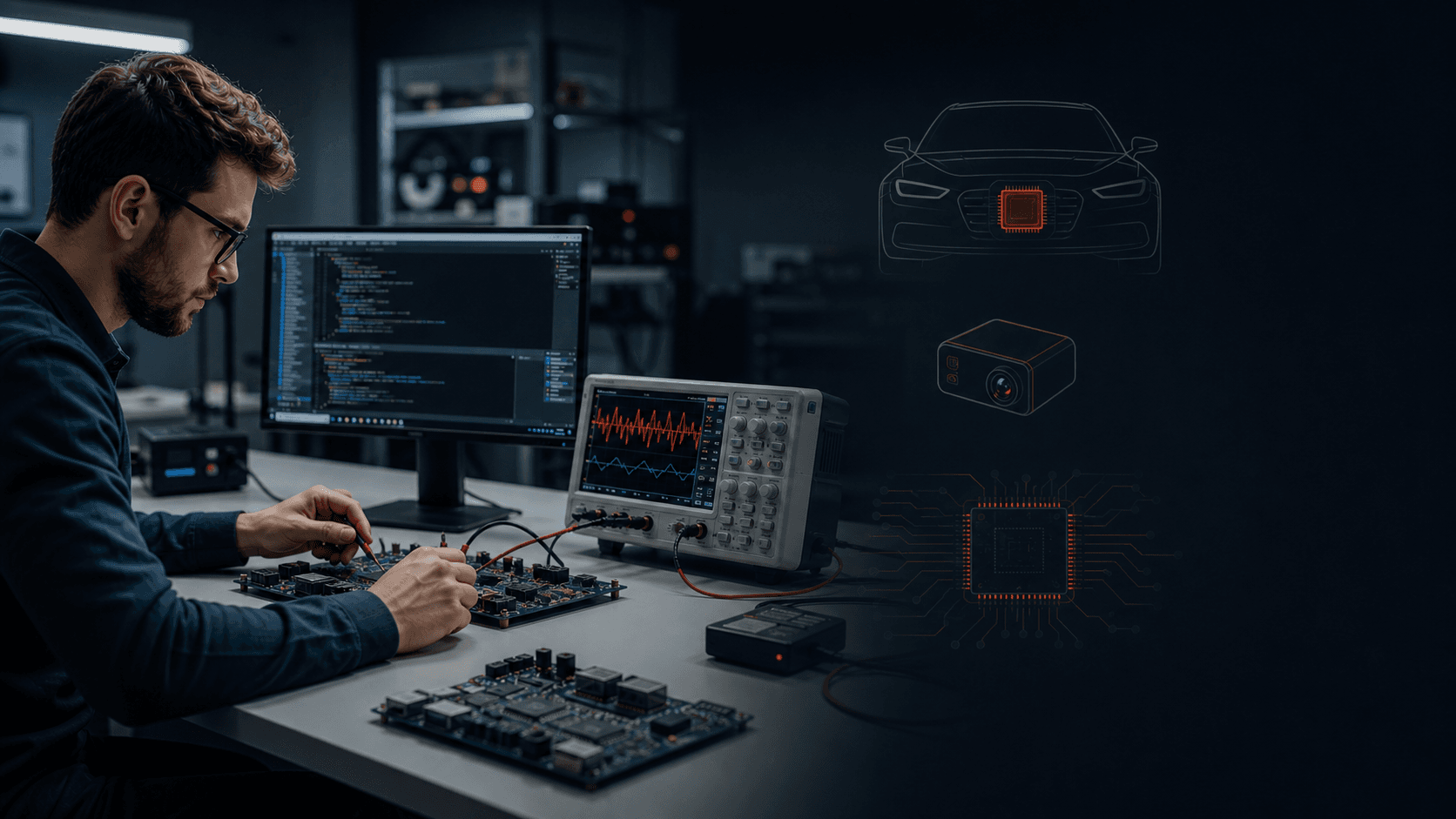
Bringing up a modern SoC means initializing power domains in the right sequence, debugging boot failures with no print output, probing signals with an oscilloscope and logic analyzer, and reconstructing what the hardware is actually doing from signal timing alone. JTAG helps when it works. When it doesn't, you're reading register dumps and comparing them line by line against the datasheet.
The engineers who are good at this share a specific capability: they can read a schematic, understand what the hardware is supposed to do, write or modify bootloader code to get there, and hold a useful conversation with the silicon team when the hardware doesn't behave the way the spec said it would. That last part is what separates them from engineers who can write firmware but can't cross the boundary.
As SoC complexity increases, this skill becomes more valuable, not less. It doesn't scale through abstraction.
The RTOS Expertise Gap
Most university embedded programs still teach bare-metal firmware: direct register manipulation, interrupt handlers, simple state machines. Useful foundation. Not what automotive or industrial roles are asking for.
Real production systems use real-time operating systems. FreeRTOS has the largest market share and is the baseline expectation for most IoT and consumer embedded roles. Zephyr is growing fast under Linux Foundation stewardship and is increasingly common in industrial and IoT. VxWorks from Wind River and QNX from BlackBerry dominate defense, aerospace, automotive, and medical, domains where deterministic scheduling is a certification requirement.
Engineers who can architect a real-time task scheduling system, design inter-task communication that doesn't introduce priority inversion, and reason about worst-case execution time for a safety-critical ECU are not common. The ones who can do this under AUTOSAR architecture are rarer still.
ISO 26262 and ASIL-D: The Hard Gate
Functional safety in automotive isn't a methodology you can pick up in a few months. ISO 26262 defines ASIL ratings from A through D, with ASIL-D being the highest integrity level, applied to systems where failure could result in life-threatening harm. Meeting ASIL-D in firmware means redundancy, formal processes, exhaustive static analysis (MISRA C compliance is the floor, not the ceiling), lockstep core verification, and a documented safety case.
Engineers who've designed ASIL-D firmware on production automotive programs, not studied the standard but actually shipped it, command a meaningful salary premium. The pool is small because the gate is real. You either have the development-process experience or you don't. Adjacent experience doesn't substitute for it.
AI at the Edge Is a Firmware Problem
The narrative around AI at the edge focuses on models. The firmware engineer's perspective is different: inference on device means managing memory-constrained execution, thermal throttling, power budgets, and real-time scheduling all simultaneously.
TensorFlow Lite and ONNX Runtime are the dominant inference runtimes appearing in embedded job descriptions, and silicon vendors are shipping NPU-specific SDKs that require low-level integration work. An embedded engineer who understands how to quantize a model to fit in on-chip memory, integrate an NPU driver into an RTOS task structure, and validate inference latency against real-time constraints is a specific profile. It doesn't come from ML backgrounds. It comes from strong embedded foundations combined with the willingness to learn the inference stack.
Where This Leaves Mid-Level Embedded Engineers
If your resume says C, FreeRTOS, Cortex-M, you're employable. You're not differentiated.
The move is to pick a domain and go deep. Automotive is the highest-premium track, but it requires patience: development cycles are long, the process is rigorous, and ASIL-D experience has to be earned over real programs. AI at the edge is moving faster and rewards engineers who can cross disciplines. Industrial and medical offer stable demand with strong safety-critical premiums for engineers who pursue IEC 62304 or IEC 61508 experience.
The generalist embedded engineer's rate is solid. The automotive ASIL-D firmware engineer's rate is exceptional. That gap has widened over the last three years and shows no sign of closing.
Game 7 places embedded firmware and BSP engineers across automotive, AI-edge, and semiconductor programs. The candidates who move quickly in our network are the ones with genuine domain depth: engineers who've shipped ASIL-D ECU firmware, integrated NPU inference stacks on real hardware, or debugged a multi-core SoC bringup from a cold power-on. Breadth gets you in the conversation. Depth closes it.
The embedded firmware role has expanded in every direction: more safety rigor, more AI integration, more hardware complexity at bringup. The engineers who've followed that expansion into one domain, and gone deep enough to have real production experience in it, are exactly where the market is rewarding depth with premium rates.
The question isn't whether demand is there. It's whether your profile reflects where demand is going. Let us help you - whether you're an engineer looking for their next opportunity or you're looking to hire embedded engineers primed for your project, we have the experts that can guide you in the right direction.
FAQ
Frequently Asked Questions
What is driving demand for embedded firmware engineers in 2026?
Three simultaneous trends are driving demand: automotive electrification requiring ISO 26262-compliant safety-critical firmware for ADAS, V2X, and battery management systems; AI at the edge requiring engineers who can integrate NPU inference runtimes like TensorFlow Lite and ONNX Runtime into real-time embedded systems; and increasingly complex SoC bringup requiring engineers who can debug across hardware and software boundaries using JTAG and signal probing. Each wave draws from a narrow talent pool, and all three are competing for the same engineers simultaneously. The combination has made the embedded firmware discipline shorter on supply than it has been in over a decade.
What RTOS skills do embedded firmware engineers need in 2026?
The RTOS platforms with the highest hiring demand are FreeRTOS (AWS-backed, dominant in IoT and consumer embedded), Zephyr (Linux Foundation, growing in industrial and IoT), VxWorks (Wind River, dominant in defense and aerospace), and QNX (BlackBerry, dominant in automotive and medical). Engineers who can architect real-time task scheduling, manage inter-task communication without priority inversion, and reason about worst-case execution time for safety-critical systems are in the shortest supply. Automotive roles increasingly require RTOS expertise under AUTOSAR architecture, which narrows the qualified pool further.
What is ISO 26262 ASIL-D and why does it matter for embedded engineers?
ISO 26262 is the automotive functional safety standard that defines Automotive Safety Integrity Levels (ASIL) from A through D. ASIL-D is the highest level, applied to systems where failure could cause life-threatening outcomes. Firmware designed to ASIL-D must meet strict requirements: MISRA C compliance, formal redundancy mechanisms, lockstep core verification, documented fault analysis (FMEDA), and a complete safety case. Engineers with production ASIL-D firmware experience command a significant salary premium because the requirement is a hard gate: adjacent experience doesn't substitute for having shipped ASIL-D on an actual automotive program.
What is board bringup in embedded firmware engineering?
Board bringup is the process of initializing a new hardware platform, typically an SoC or custom PCB, from power-on through a functional software stack. It involves initializing power domains in the correct sequence, configuring clocks and memory controllers, debugging boot failures using JTAG and oscilloscopes, and modifying bootloader code to match actual hardware behavior. On complex modern SoCs with multiple heterogeneous cores and power domains, bringup engineers are frequently the first to discover hardware bugs and must communicate findings to silicon design teams. The ability to read schematics, probe signals, and work across the hardware/firmware boundary defines a strong bringup engineer.
How should embedded firmware engineers pick a specialization for career growth?
The three highest-demand specialization tracks for embedded engineers are automotive (ISO 26262, ASIL-D, AUTOSAR), AI at the edge (NPU integration, TensorFlow Lite, ONNX Runtime, real-time inference optimization), and complex SoC bringup (multi-core initialization, bootloader development, JTAG debugging). Automotive carries the highest salary premium but requires investment in safety-critical process experience across real programs. AI at the edge is accelerating fastest and rewards engineers who combine real-time firmware depth with inference stack knowledge. The compensation gap between a generalist embedded engineer and an ASIL-D automotive firmware engineer has widened significantly over the last three years.
Written by
Jason Eisenberg
Head of Marketing